
Some of the best discoveries are the ones we never set out to make.
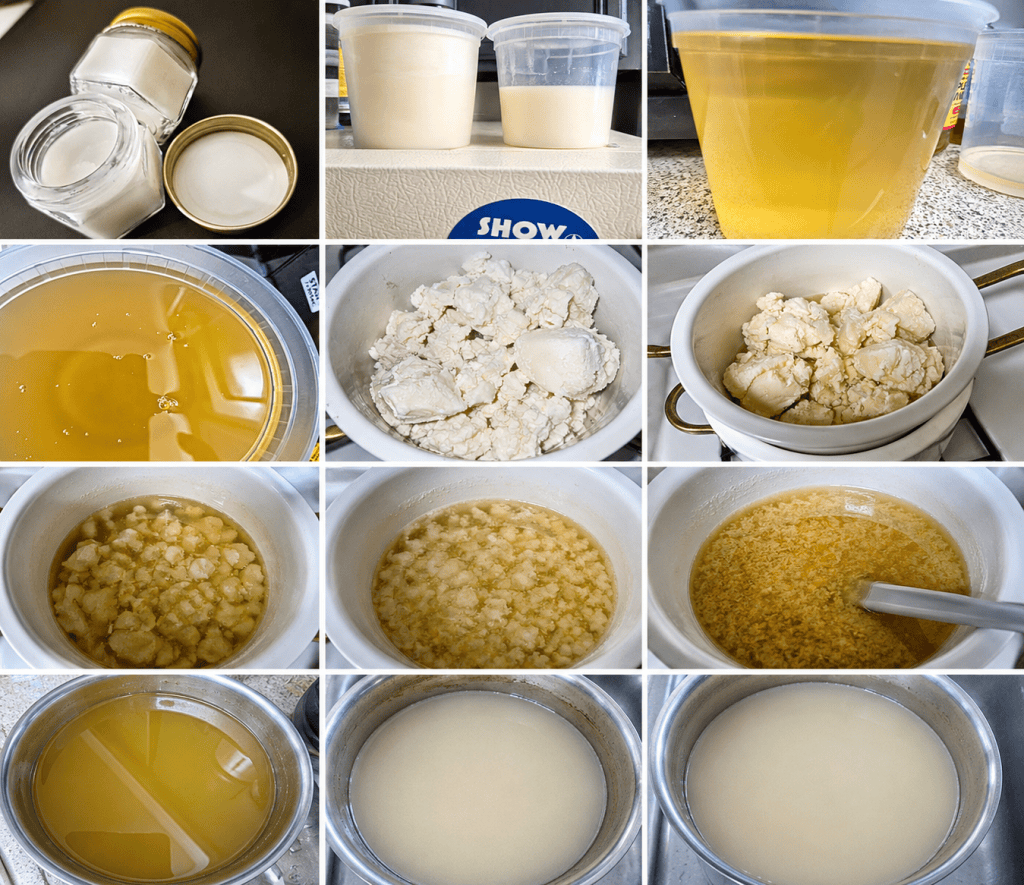
A few months ago, I rendered beef tallow for the first time. My intention was simply to look for an alternative to seed oils for cooking. After sourcing beef fat from a local farm, I spent hours slowly rendering it by hand until it became clean, smooth tallow ready for my kitchen.
Tallow is made by slowly rendering animal fat, most commonly beef fat. The raw fat is first trimmed of excess meat and connective tissue, then cut into smaller pieces. It is gently heated over low temperatures, allowing the fat to melt while the water evaporates and the remaining tissues separate from the liquid fat.
I rendered mine using a bain-marie that was gifted to me by a friend. The only other time I have used a bain-marie was when my late husband taught me how to make bearnaise sauce…but I digress.
It took me 30 hours to render 2 quarts of fat trimmings, so I started on a Friday and finished the day after.
Once the rendering process is complete, the melted fat is strained through a fine mesh or cheesecloth to remove the browned solids and any remaining impurities. The purified liquid is then allowed to cool. As its temperature drops, it changes from a clear golden liquid into a firm, creamy-white solid known as tallow.
While researching tallow, I discovered that for centuries it has been valued for its stability, long shelf life, and versatility. It has been used in cooking, soap making, candle making, leather conditioning, and skincare.
Although modern manufacturing has introduced many alternatives, traditionally rendered tallow continues to be appreciated for its simplicity and wide range of practical uses.
What surprised me most, however, was its scent. I had expected it to smell like cooked animal fat or lard, but it doesn’t. Properly rendered tallow has a very mild aroma that is far subtler than the smell we typically associate with cooking fats. My guess is that the slow, gentle rendering process allows the fat to melt without developing the stronger “cooked fat” scent we are familiar with in the kitchen. While I can’t say with certainty that this is the reason, it seems like a plausible explanation.
Curious, I set aside some in small jars and decided to try it exactly as it was—100% pure tallow, with nothing added. For the next month, that simple jar became my daily moisturizer. The experience surprised me.
There was no elaborate formula, no long list of ingredients to decipher, no fragrance to mask what it was. Just carefully rendered tallow, prepared the same way every time. The more I used it, the more I appreciated its simplicity, and what began as a personal experiment slowly became a daily ritual.
While researching tallow, I discovered that for generations it had also been used as a skin moisturizer. Curious, I set aside a small jar and decided to try it exactly as it was—100% pure tallow, with nothing added.
For the next month, that simple jar became my daily moisturizer.
The experience surprised me. There was no elaborate formula, no long list of ingredients to decipher, no fragrance to mask what it was. Just carefully rendered tallow, prepared the same way every time. The more I used it, the more I appreciated its simplicity, and what began as a personal experiment slowly became a daily ritual.
At this stage, my balm is intentionally uncomplicated: 100% pure rendered tallow. Nothing more. I believe that simplicity deserves its own place in modern skincare. I never intended to create a skincare product.
I simply discovered something worth sharing. It’s been 2 months now, and I still use my home-made tallow daily to moisturize my skin.


Leave a Reply